Commercial product · in active development
NextConsensus
Which medical claims are gaining support, and where.
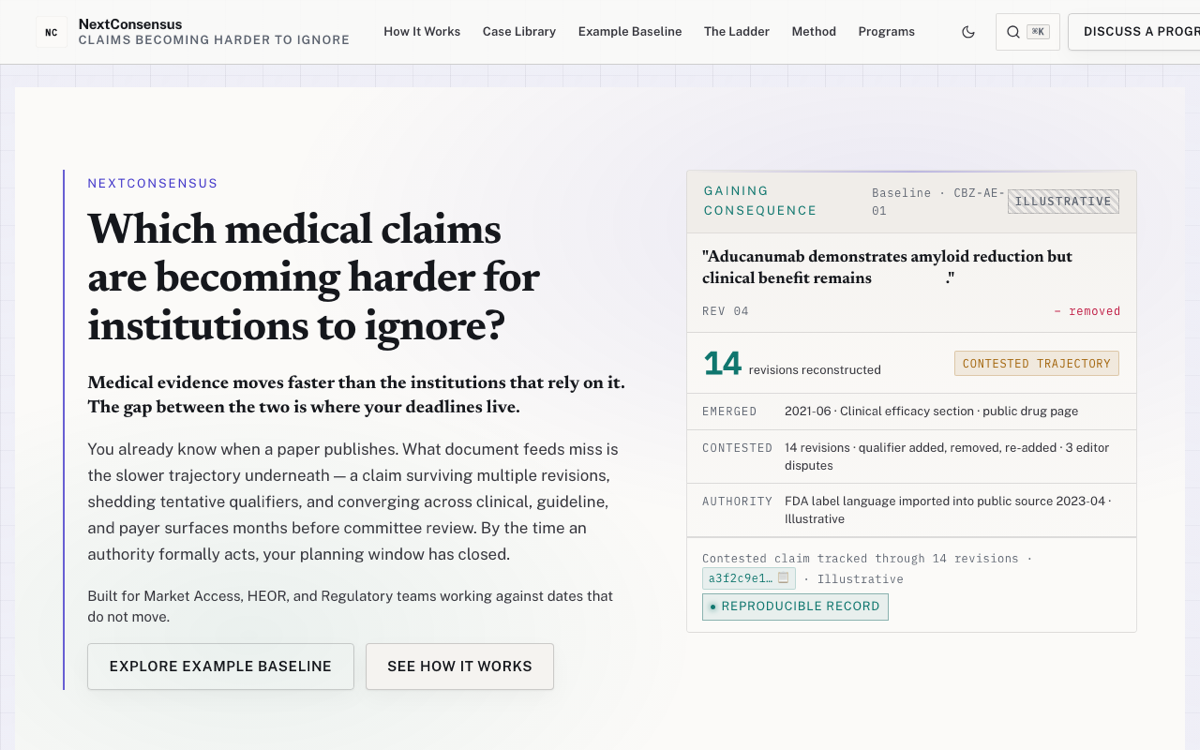
I built NextConsensus because a publication feed tells you when a paper comes out, not how a claim changes over time: whether it survives revisions, loses its early caveats, and starts appearing in sources that used to disagree with it. By the time a guideline or coverage decision changes, there is little time left to prepare.
Why position changes arrive as surprises
A formal label or guideline change is the last snapshot of a shift that has been building for years. Because the drift reads as random delay, biopharma teams are repeatedly caught reacting after the change has already landed.
A safety signal that persists across revisions carries different weight from a transient spike, yet keyword searches treat them identically. Tracking a claim across revisions tells the two apart.
A single unanticipated coverage restriction or advisory delay can alter the economics of an entire portfolio. The research asks whether changes in evidence can help anticipate changes in guidelines and coverage.
How it works
- 01 Extract Refract replays public revision history into dated, verifiable events. NextConsensus classifies those events into claim trajectories: wording changes, citation movement, certainty shifts, and propagation.
- 02 Classify Each event is labeled as evidence that actually moved, the public catching up, an official body’s wording being copied in, editorial upkeep, or noise.
- 03 Prioritize Claims are ranked by how far and which way they moved: gaining support, shedding qualifiers, spreading across influential sources, or appearing in regulator or guideline language.
- 04 Deliver Each ranked claim comes with the revision history behind it, so a team can investigate, brief, or escalate.
Most of the work is in the classify step. Without it, a burst of editorial housekeeping ranks identically to a claim genuinely gaining ground.
What it is built on
Trajectories are reconstructed by Refract, the open-source engine underneath (AGPL-3.0): the same source produces the same events on every run, so a result can be checked instead of taken on trust. Its behavior is published, not just described: each release ships a test set of recorded edits that anyone can regenerate byte for byte.
The same properties let software use it, not just people. An agent reasoning about a claim needs the dated events and their sources, not a summary of them — and a result it can recompute is one it can check rather than trust.
Select a layer for detail.
Without this layer
The live public record at nextconsensus.com is the authoritative account of every forecast filed.
What it does not do
- It measures how a claim’s standing has moved: whether it gained or lost support in the evidence and in official sources, and by how much. It does not judge what is medically true.
- Rankings report how far evidence has moved, not the odds a claim is right. Probabilities belong to the forecasting research, and no registered forecast has resolved yet.
- What is built is the record. A forecast is a query against it, so there is no forecast where the record does not reach yet.
- It does not recommend an action. The resulting decision to brief, escalate, or wait stays with the team that owns it.
My role
Founder and primary builder. I built the registration system, deterministic claim-scoring engine, trajectory-reconstruction pipelines, and public resolution rules on top of Refract, the open-source change-detection engine underneath it.
Continued The rest of what I’m building Ambit, Refract, and the evaluation work around themRevised