
Case study 5 of 5 · Decided by who pays
Reading the contract before the physician signed it
I co-founded Andwise and built software that read a physician’s employment contract and flagged the clauses worth arguing about. Each analysis went to a named reviewer, on a deadline, before the physician acted on it.
-
1,200+
Physician users
Plus a 700-member community that grew alongside them.
Context
Early-career physicians faced high-stakes financial decisions on debt, contracts, and home buying with no unbiased guidance.
The decision
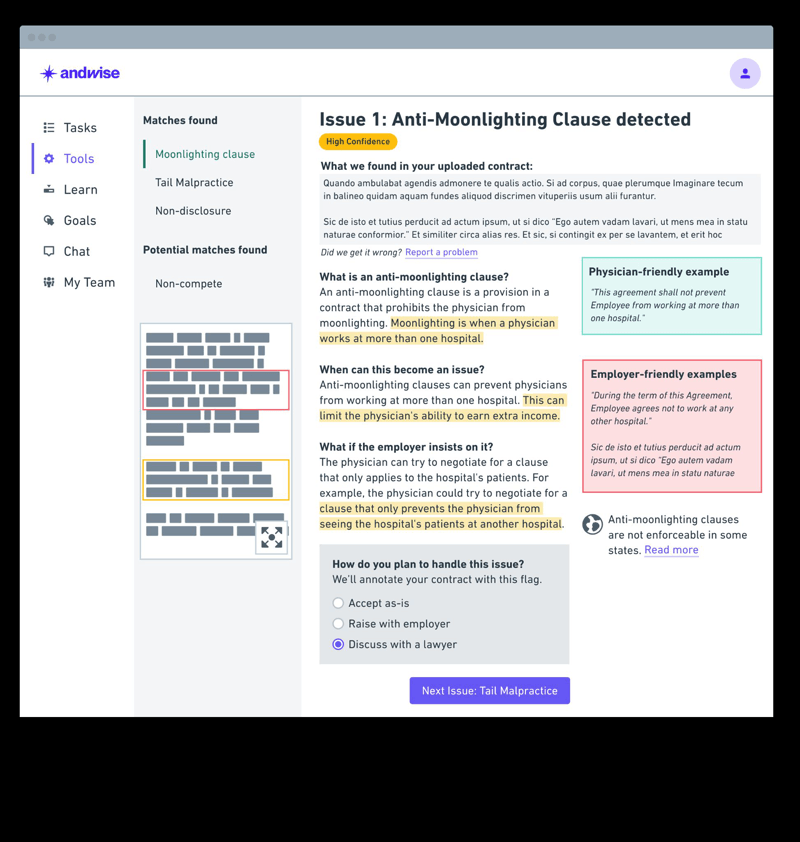
I built clause-level analysis that flagged the clauses worth arguing about, overseen by a medical advisory board, with every analysis routed on an escalation clock to a named reviewer for sign-off. I drew the line between what the software did and what it refused to do in the product itself, not in a disclaimer.
Direct physician subscription Not chosen
The aligned option: the physician pays, so the product answers to the physician. What it could not do was fund growth — acquisition cost exceeded lifetime value at every price we tested.
Hospital or employer benefit Not chosen
The employer pays and the product is sold as a benefit. It meant a twelve-month sales cycle and reporting on which employees used it, which breaches the confidentiality the product existed to protect.
Advisory or wealth-manager referral Not chosen
The highest revenue per user, and the one that inverts the premise: the advisor pays for the introduction, so the physician becomes the product rather than the customer.
The fourth option was the one taken: wind the company down in 2024. Sign-ups showed physicians wanted it, but the payer who was aligned could not sustain the company, and the payers who could sustain it would each have moved the customer seat away from the physician.
To the medical advisory board on 29 May 2024: “we haven’t been able to overcome financial hurdles and achieve the user engagement we’d hoped for. As a result, we’ve made the tough decision to wind down operations.” Who pays decides who the product works for, and I should have settled it in year one. I found out in year two.
Where the analysis stopped
It did
- Surfaced the clauses worth arguing about, highlighted in the contract itself.
- Explained each one in plain language, with a stated confidence level.
- Showed physician-friendly and employer-friendly framing side by side.
- Routed every analysis to a named reviewer on an escalation clock.
It did not
- Advise. The analysis surfaced and explained, and stopped there.
- Decide how a clause should be handled. Accepting, raising or escalating to a lawyer stayed the physician’s choice.
- Author legal content — that was a JD’s job, not the software’s.
What happened
I convened a physician medical advisory board, designed review routing with escalation clocks, and shipped plain-language summaries signed off by a named reviewer. Alongside the Contract Analyzer, Andwise kept a free directory of more than 70 financial advisory firms, and took no payment for a listing. 2 Andwise Medical Advisory Board 3 Andwise advisor directory
Andwise reached 1,200+ physician users. I wound it down in 2024.
What I’d keep
Who pays decides who the product works for. Adoption proves people want it; it does not settle that.
Software changed the economics of expert advice here: it cut the labor per analysis, while trust, context, and a named reviewer’s time stayed as expensive as ever. The cost moved; it did not disappear.
Every path that could fund growth put an employer or a bank in the customer seat. The wind-down exposed the assumption I had never tested: that enough user value would eventually produce a business model that kept the physician as the customer.
The escalation clocks are the PQRS escalation path from Epic, built for contracts instead of quality reporting: every trigger gets a default action, a responsible reviewer, and a time-bound record. That part worked. The rule this study added is the one no route could fix.
Sources
1 Andwise founding
Andwise was co-founded by Kanav Jain and Dr. Varun Verma in 2022.
Andwise’s own page naming its founders.
2 Medical advisory board
Andwise maintained a physician medical advisory board. The public roster names 21 physicians, including co-founder Dr. Varun Verma.
The advisory board’s public roster, counted on 28 August 2026: 21 named physicians. The page is a 2024 snapshot of a site no longer maintained, so it may miss people who served at other times.
3 Advisor directory
Andwise published a directory of financial advisors for physicians and took no compensation for listings.
The directory’s own disclaimer: Andwise “is not affiliated with any of the advisors listed and does not receive compensation for their presence in our directory.”
Documents described, not republished
- Physician medical advisory board The public roster survives; no charter does. The review scope and authority described here come from my records.
- The 29 May 2024 wind-down email The email to the medical advisory board and April 2023 investor updates, recording the decision to wind down operations rather than build on an unaligned employer or financial advisor referral model.
Andwise wound down in 2024 and most of its internal working documents did not survive. Public sources above confirm the founding, the advisory-board roster, and the directory’s terms. The wind-down email and the investor updates come from my own email.
Revised